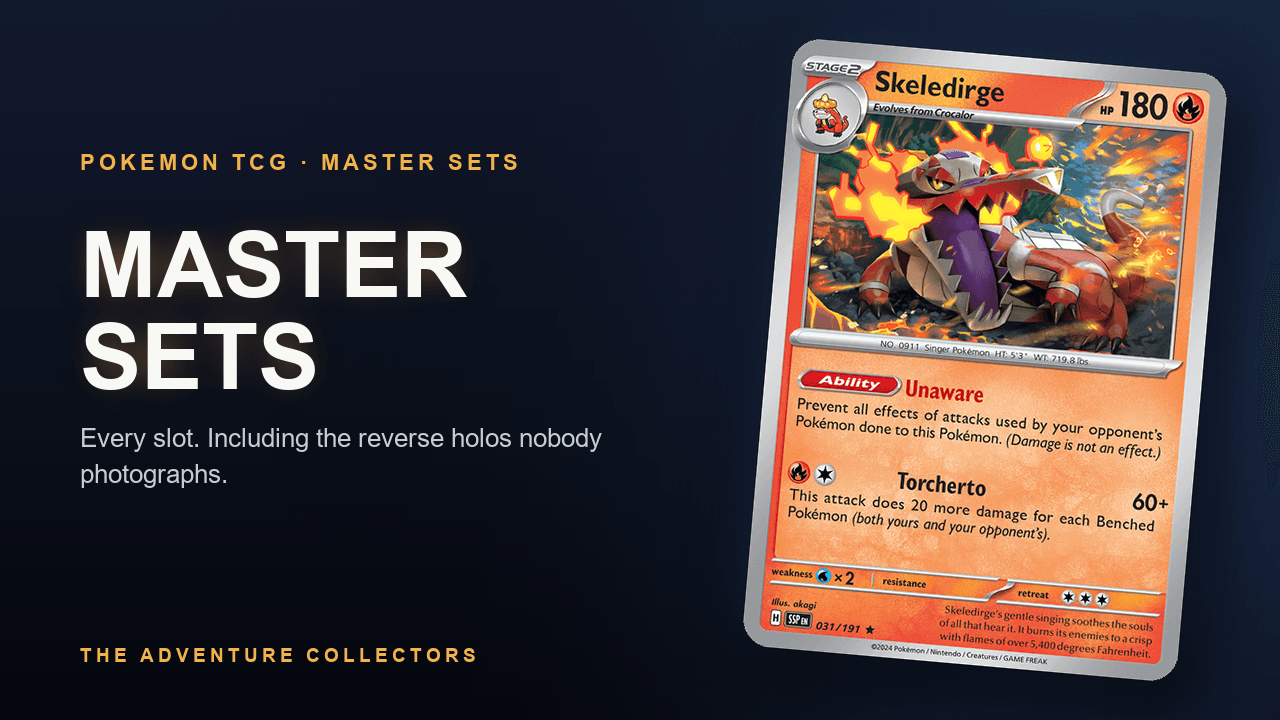
What Is a Master Set? How We're Building Ours (And Why It Takes Longer Than You Think)

A Pokémon master set is every card in the set. Not just the pulls you're proud of — every single slot.
That means the commons. The uncommons. The regular rares that come out of every other pack. And critically, it means a reverse holo version of each one of those too. When people hear "master set," they sometimes picture a binder full of Special Illustration Rares and full arts. The reality is that the bulk of the work — and the bulk of the slots — belongs to the unglamorous cards. The ones you'd normally toss in a bulk pile.
Once you really internalize that, the scope of the project shifts. Surging Sparks has 252 cards in its main and secret rare sets. Add in the 165 reverse holo-eligible cards (commons, uncommons, and rares), and you're chasing 417 slots. Perfect Order runs 124 base cards, with 79 of those getting reverse holo treatment. Mega Evolution Base Set is its own mountain. These are long-term commitments — not a weekend project.

How We Got Into This
We came back to Pokémon collecting in late 2025 after a long break. Since then, a few sets have released, we've had time to see what we actually want to focus on, and a pattern has emerged: when we commit to a set, we commit to the whole thing.
That's just how we're wired. We're not casual organizers who slot in whatever pulls we happen to get and leave gaps without thinking about it. Once a binder exists for a set, the incomplete slots bother us. We've started (to some degree) a few different master sets that we're working on currently — Surging Sparks (sv8), Perfect Order (me3), and Mega Evolution Base Set (me1), while Collector Sis is slowly doing Prismatic Evolutions as well — and we're under no illusions about how long these will take.
We've talked a bit about the master set mindset in our Master Set Monday series, but this post is more about what actually goes into building one.
What People Assume vs. What It's Actually Like
The assumption is that you go to a card show or hop on TCGplayer and just... buy what you're missing. And eventually, yes, that's part of it. But especially early in a set, it's a much more layered process.
First: open packs. This is where you build your base. Packs are unpredictable — you might hit a Special Illustration Rare and still leave with a bunch of gaps in the commons. But every pack advances the project. We grab packs when we can, at a slow and steady pace. An Elite Trainer Box is a special occasion; we're not breaking cases. Obviously this also depends on the age of the set. For newer sets coming out today, we definitely take this approach. Older sets where packs are outrageous because of the super expensive chases? We'll probably start those by bulk hunting. Speaking of...
Second: dig through bulk. Local shops, card shows, bulk bins — this is where master sets actually get built. Commons and uncommons are cheap because no one is chasing them. You can knock out a dozen slots for a few dollars if you know what you're looking for and you're willing to flip through boxes. The reverse holos are in there too, and they're often priced like the base versions if you catch the right shop on the right day. It can take some time (Collector R has a hard time with this sometimes while we're out digging through boxes at shops when all the sealed on the wall is calling his name), but it's worth it.
Third: acquire the big hits over time. The Special Illustration Rares, the Hyper Rares, the full arts — those come slowly and deliberately. We're not rushing to complete those sections. A card like an SIR from Surging Sparks or the top pulls from Perfect Order can sit as a proxy in the binder for a while. That's fine. That's the point.
This isn't a race to completion before the next set drops. We're a family collecting at a pace that makes sense for us, and these sets will get there when they get there.
The Proxy Binder — Our Favorite Part of the Process
This is the piece we don't see talked about enough, and honestly it's one of our favorite parts of the whole hobby.
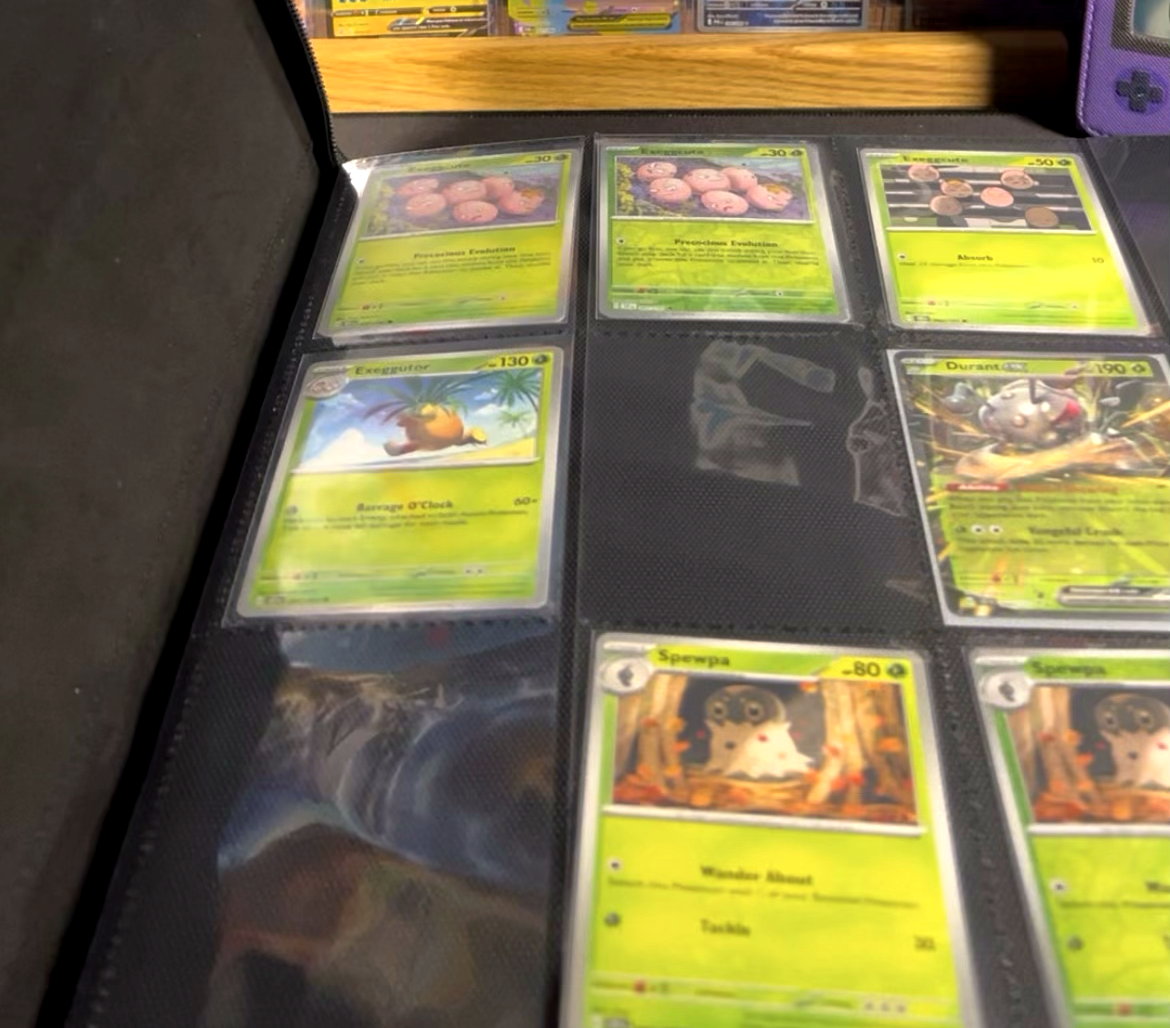
When we start a new master set, we sometimes print black-and-white proxy placeholders for every card we don't have yet. The binder goes in completely — every slot filled with a proxy standing in for what we're hunting. The whole set, accounted for, from day one.
There is something genuinely satisfying about a full binder, even when most of it is still black and white.
The proxy system does two things at once. It keeps everything in order — no shuffling cards around later, no figuring out where a new pull belongs. You find a card at a show, pull it from a pack, or pick it up as a single, and there's already a place waiting for it. Swap the proxy out, slide the real card in. Done.
But the second thing is the part we didn't expect to love as much as we do: watching the binder go from mostly black-and-white to full color over time. Every new card that goes in is a visible change. The binder gets a little more colorful. The proxies get a little fewer. That visual progress is its own reward — it makes the slow pace feel like movement instead of waiting.
You can follow our progress on the live binders right here on the site — our Surging Sparks Master Set Monday post — where we track what we've found and what's still missing.
Why the Long Game Is Worth It
We're not going to pretend that master setting a Pokémon set is for everyone. It takes patience. It takes discipline about not jumping to the next shiny set before the current one is done. And it means spending a lot of time thinking about commons and uncommons, which is not exactly glamorous.
But there's something that a random collection of cool cards doesn't give you. When every slot is your own deliberate decision — when you can look at a binder and trace back every single card to a moment (a show, a pack, a trade) — it feels like something you actually built. Not something that happened to you.
The Surging Sparks binder has a long way to go. So do Perfect Order and Mega Evolution, and especially Prismatic Evolutions with all the Pokeball and Master Ball variants that are hard to come by. And we're good with that. Each card that moves from proxy to real is a small win, and right now we've got a lot of small wins ahead of us.
We'd Love to Hear How You Approach It
Do you master set? And if so, how do you decide which sets are worth committing to? Do you start the binder right away and organize from day one, or do you keep cards loosely together until you've got enough to work with?
Which sets are you master-setting right now, and have you ever completed one? Come tell us over on YouTube, or find us on X at @Adventure_Coll — we genuinely want to know how other collectors tackle this.
Got thoughts on this one?
Come talk it over with us on X — we read every reply.
Share this post
Related Posts

The Pokémon Apps We Actually Use (And the One That Stuck)
Jul 22, 2026
Pokémon GO, TCG Pocket, TCG Live, the Lorcana app and TCGplayer all live on our phones. Here's which ones we actually open, which one turned into a daily ritual, and which one we keep meaning to play more.
How Do Pokémon Print Runs Actually Work These Days?
Jul 20, 2026
We used to think a set finishing meant it was gone for good. Reprints of Prismatic Evolutions and Pokémon 151 have us rethinking when products actually stop printing, whether they can come back, and what it all means for finishing a binder on a budget.

Why the Japanese Side of Pokémon Keeps Catching Our Eye
Jul 18, 2026
We're sticking to English for now, but the non-English side of the hobby keeps pulling our attention, from bulk 'finds' that turn out to be Japanese to some of the coolest exclusive cards we've ever seen.