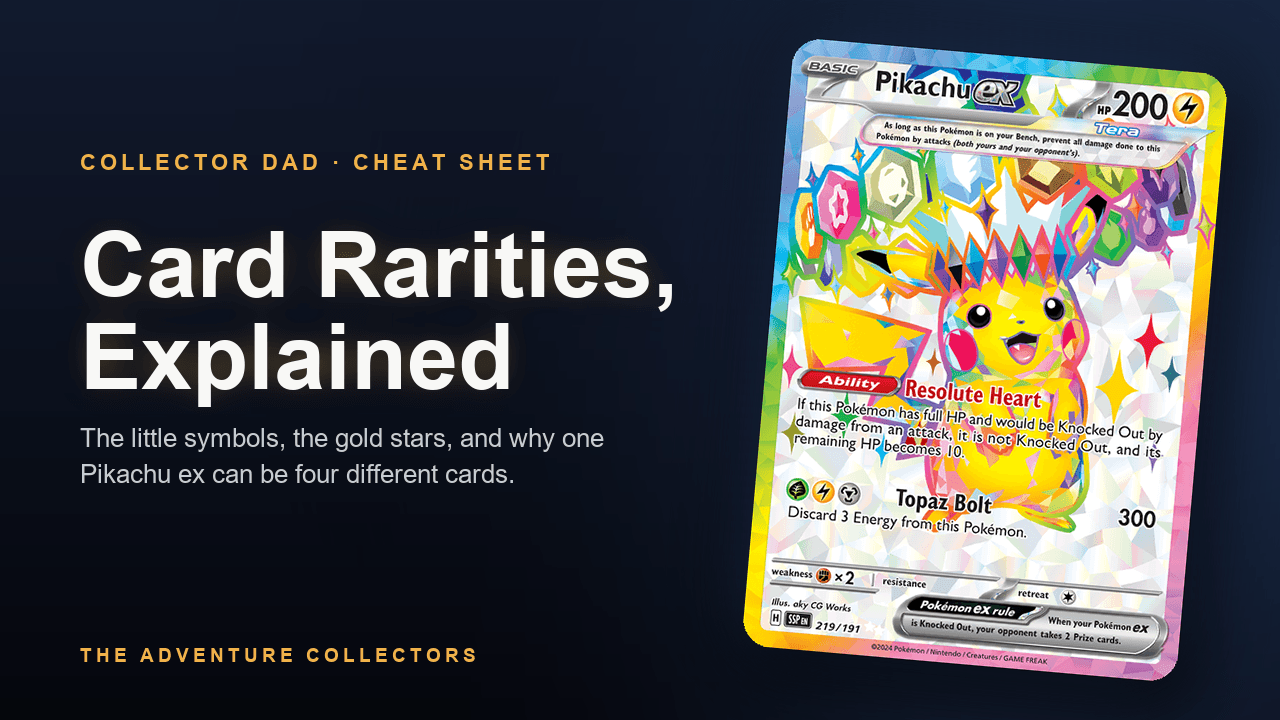
Pokémon Card Rarities, Explained: A Collector Dad's Cheat Sheet

When we first got back into Pokémon cards with the kids, the rarities were honestly one of the most confusing parts for us to wrap our heads around while we were opening packs. There are little symbols in the corner, there are gold stars, and there's a card that looks a lot like another one but costs ten times as much. It took us a while to sort it out, even for the sets we're actively collecting now. Then we started thinking about picking up some older sets, and maybe a little vintage someday, and realized the rules aren't quite the same the further back you go. So we wrote down the simple version for ourselves. If you're newer to this, or figuring it out next to your kids like we are, here's the whole thing in plain English.
Start with the little symbol
The easiest place to start is the tiny symbol in the bottom corner of most cards. It tells you the base rarity, and this part has stayed the same for over twenty years:
A circle means Common. These are the cards you pull the most of.
A diamond means Uncommon. A step up, but still easy to find.
A star means Rare. In today's sets, these are always shiny (what collectors call "holo," short for holofoil).
You'll also hear the term reverse holo. That's not a different rarity. It's just a variant version of a card where the shiny foil covers the background instead of the artwork. A common, uncommon, or rare can each come as a reverse holo. Hang onto that one, because it matters later if you're planning on doing a master set.
Then come the fancier cards
Above those three is where the cards people chase live. This is where the names start to pile up, so here they are, simplest to fanciest:
Double Rare (two black stars). This is where the regular ex cards sit. An "ex" is just a stronger, flashier version of a Pokémon, and these are a normal part of the base numbered set, not some impossible pull.
Ultra Rare (two silver stars). The full-art version of an ex card, meaning the artwork stretches across the entire card. Some special trainer cards get this look, too. These are the ones that start to spill outside the bounds of the numbered set, for example, card 101/100, where 100 indicates the main set, where everything after is the rarer cards.
Illustration Rare (one gold star), usually shortened to IR. A regular Pokémon given a gorgeous full-art card, often shown in its own little scene.
Special Illustration Rare (two gold stars), or SIR. The same painted, full-art idea, but for an ex card. These are usually the prettiest cards in a set, and the most wanted.
Hyper Rare (three gold stars). The shiny gold-bordered "gold cards." If you want the deep dive, we wrote one on what a Mega Hyper Rare actually is.
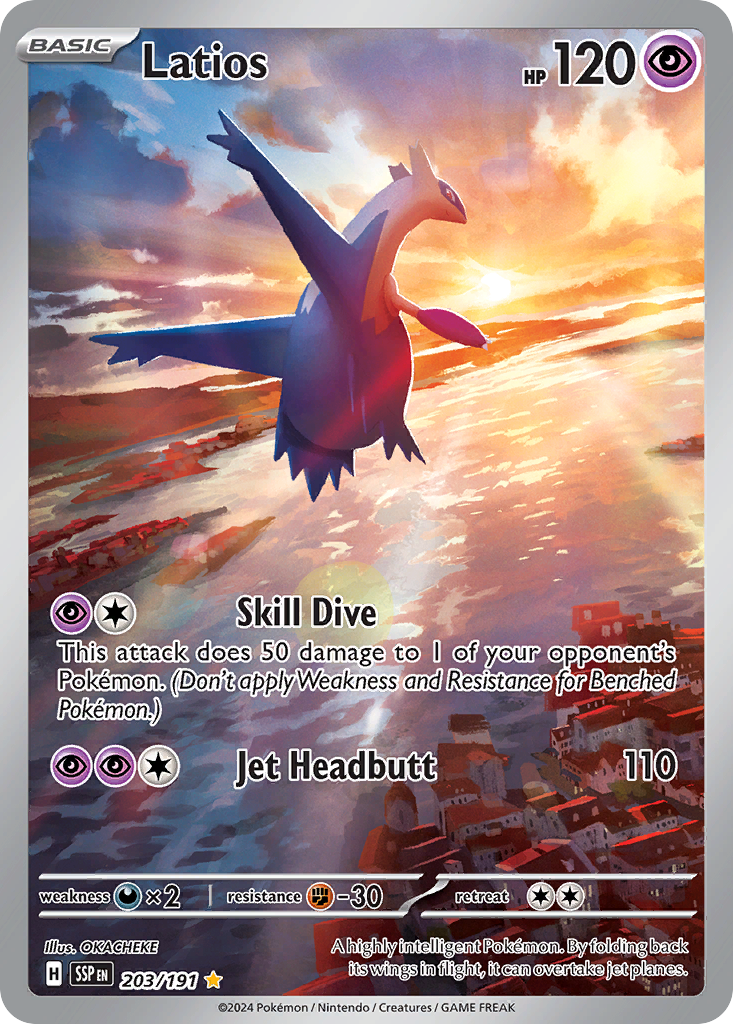
This is an Illustration Rare (one gold star): the Latios from Surging Sparks, a regular Pokémon given its own full-art card. You can see it's card # 203 out of the base 191 card set, meaning it's outside the base set and in the chase portion of the set.
The part that finally made it click
"ex" isn't a rarity. It's a type of card that can show up at several different rarities.
The best example is right in Surging Sparks, the set we've been slowly filling in. The exact same Pikachu ex shows up four separate times, at four different rarities. Same Pokémon, four completely different cards, and the price climbs fast:
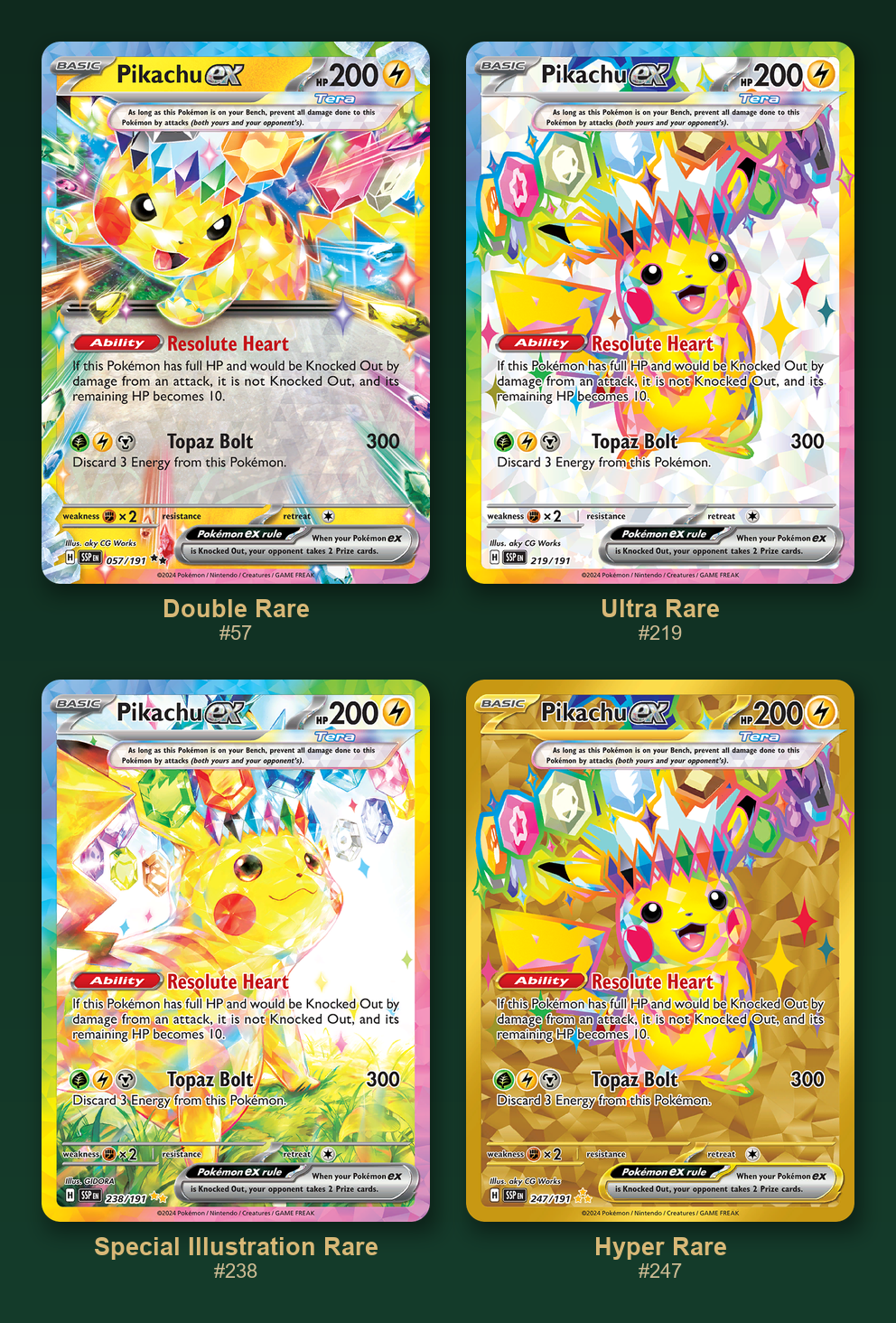
One Pikachu ex, four rarities in the same set. Same Pokémon, four very different cards.
The plain version (#57) is a couple of dollars and lives happily in lots of binders. The Special Illustration Rare (#238) is the painted one everybody wants, and it sells for around $330 on the resale market (what collectors call the "secondary market," basically eBay and card-selling sites). That one is a firm "admire from afar" for us, since we're a pack-here-and-there family and not out hunting $200-plus cards. You can follow which of these actually turn up for us in our Surging Sparks binder here on the site.
This also cleared up something we'd wondered about. We used to think "secret rare" meant the ex cards. Really, it's just an old term for any card numbered higher than a set's normal count (like card #238 in a set that "officially" ends at 191).
Tip: remember reverse holos? Here's why they matter. If you ever decide to collect a master set (one of every card in a set), you also need the reverse-holo version of every common, uncommon, and rare. That roughly doubles your list, or in the case of Prismatic Evolutions, can nearly quadruple it when there's reverse holos, pokeball, and master ball variants. It's the difference between a fun weekend and a real project.
Older sets play by older rules
Here's where our cheat sheet runs out. We don't own many vintage cards yet, but while we've been eyeing older sets, we noticed something. The little circle, diamond, and star at the bottom have barely changed since the '90s, but the big "chase card" at the top gets a brand-new name in almost every era. The short, plain-English history goes like this:
1999–2003: back when a company called Wizards of the Coast ran the Pokémon card game, the biggest chase was simply a Rare Holo (a rare with a shiny picture). The "1st Edition" stamped cards people prize come from this stretch.
2003–2007: the lowercase ex cards appeared for the very first time. Funny enough, they're back in today's sets.
Early 2010s: cards got a capital EX, the first full-art cards arrived, and Mega Evolutions showed up as Mega EX.
2017–2019: the big cards were called GX, and colorful "rainbow rares" first appeared.
2020–2022: the chase cards were V, then VMAX, then VSTAR.
2023 to now: the lowercase ex came back, along with the Illustration Rare and Special Illustration Rare cards we started with.
The handy part is you can almost guess how old a card is just from its big card type. See a GX? That's around 2017 to 2019. A VMAX? That's 2020 to 2022. The one tricky one is "ex," since it was used way back and again today, so if you see one, check the little copyright year on the card to tell them apart. That trick alone has made digging through older cards a lot less intimidating for us.
What actually matters for a family collection
If your house is anything like ours, you don't need to memorize all of this. Honestly, three things cover most of it: read the little symbol so you know the base rarity, remember that reverse holos are their own separate thing, and treat the pretty illustration cards as the fun stuff to hope for rather than the reason you buy a pack. Everything else you'll pick up one card at a time, the same way we are.
So we'll turn it over to you. How do you explain rarities to your kids without their eyes glazing over? And if we're finally going to try an older set, which one should be our first? Come tell us over on YouTube, or tag us on X @Adventure_Coll. We're taking notes.
Got thoughts on this one?
Come talk it over with us on X — we read every reply.
Share this post
Related Posts
Drops Are Wearing Us Out, So We Went Hunting for Singles Instead
Jul 30, 2026
2 a.m. Target alarms, an 8 p.m. Walmart scramble, and the one lucky Pokemon Center queue that landed us Pitch Black. Here's why we're leaning into local singles hunts instead, and where our Mega Evolutions binder stands heading into the 30th Celebration.
What Is a Master Set? How We're Building Ours (And Why It Takes Longer Than You Think)
Jul 27, 2026
A master set isn't just the chase cards — it's every slot, including all reverse holos. Here's how we're building ours across three Pokemon sets, and why it's a long game.

The Pokémon Apps We Actually Use (And the One That Stuck)
Jul 22, 2026
Pokémon GO, TCG Pocket, TCG Live, the Lorcana app and TCGplayer all live on our phones. Here's which ones we actually open, which one turned into a daily ritual, and which one we keep meaning to play more.